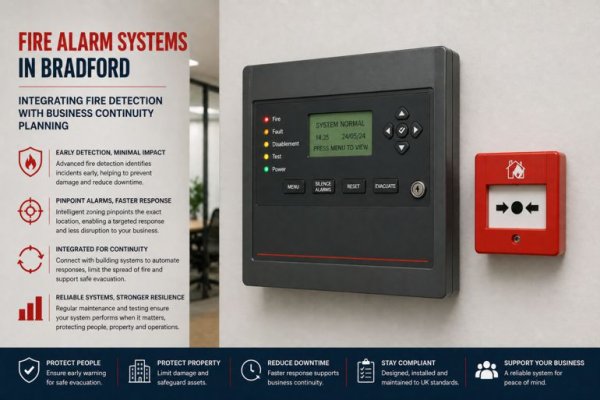
Business Continuity – For businesses in Bradford, fire alarm systems are often viewed purely as a life safety requirement. While this is their primary role, they also play a critical part in business continuity planning. A well-designed fire alarm system does more than trigger evacuation — it helps minimise disruption, protect assets and support a faster recovery following an incident.
In many commercial environments, the impact of a fire goes far beyond the immediate damage. Downtime, loss of stock, interrupted operations and reputational impact can all have long-term consequences. This is why fire alarm systems in Bradford should be considered as part of a wider risk management strategy, not just a compliance measure.
Early detection is the foundation of this approach. The sooner a fire is identified, the greater the chance of containing it before it escalates. Modern fire alarm systems use intelligent detection technology to identify fire conditions at the earliest possible stage. This reduces the likelihood of a small issue becoming a major incident.
Zoning is particularly important in larger or more complex Bradford premises. By dividing a building into clearly defined areas, the system can pinpoint the exact location of an alarm. This allows for targeted response, enabling staff or emergency services to focus on the affected area quickly.
Integration with other systems is a key aspect of business continuity. Fire alarms can be linked with access control, HVAC systems and building management systems to trigger automated responses. For example, doors can be released, ventilation systems shut down or specific areas isolated to prevent the spread of fire and smoke.
Remote monitoring is increasingly used in commercial settings. This allows alarm activations to be communicated instantly to key personnel or monitoring centres, ensuring that action can be taken even if the building is unoccupied. For Bradford businesses operating outside standard hours, this adds an additional layer of protection.
System reliability is critical. A fire alarm system that fails to operate correctly can have serious consequences. Regular maintenance ensures that all components are functioning as intended and that the system remains compliant with relevant standards.
False alarms must also be managed effectively. Frequent unwanted activations can lead to complacency and disruption. As discussed in other contexts, proper system design, correct detector selection and regular servicing all help reduce false alarms while maintaining safety.
Staff training is an often overlooked element of business continuity. Employees should understand how to respond to alarms, including evacuation procedures and basic system awareness. A well-trained team can respond more effectively, reducing confusion and improving safety outcomes.
Documentation supports both compliance and continuity. Records of system design, maintenance and testing provide assurance that the system is reliable and properly managed. In the event of an incident, this documentation can also support investigation and recovery.
Fire alarm systems should be reviewed regularly as part of ongoing risk management. Changes in layout, occupancy or operations can introduce new risks that require adjustments to the system. In Bradford commercial premises, where businesses evolve over time, this is particularly important.
Coordination with emergency planning is essential. Fire alarm systems should align with evacuation strategies, assembly points and communication procedures. This ensures that all aspects of fire safety work together effectively.
For businesses with critical operations, additional measures may be required. This could include enhanced detection in sensitive areas, redundancy in system design or integration with suppression systems. These measures help ensure that operations can recover quickly following an incident.
Ultimately, fire alarm systems in Bradford should be seen as a core component of business resilience. By combining early detection, intelligent design and integration with wider systems, they provide more than just compliance — they support continuity and long-term protection.
For Bradford businesses, investing in a well-designed and properly maintained fire alarm system is not just about meeting regulations. It is about safeguarding operations, protecting assets and ensuring that the business can continue to operate even in the face of unexpected events.