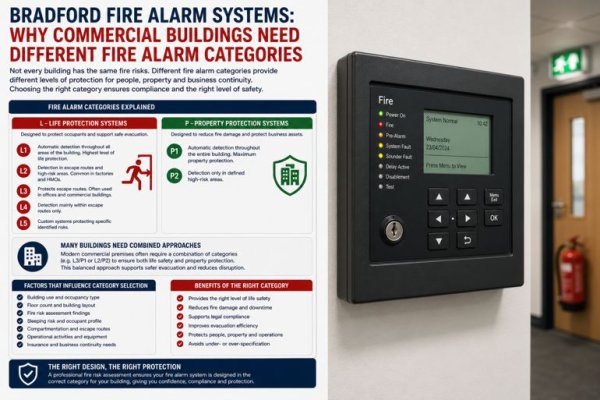
Fire Alarm Categories – One of the most misunderstood areas of commercial fire alarm design is the use of fire alarm categories. Many businesses in Bradford install systems without fully understanding what level of protection their premises actually require. However, different buildings, risks and occupancies often demand very different fire alarm strategies.
A properly designed commercial fire alarm system should never be “one-size-fits-all”. The correct category determines:
- detector coverage
- evacuation protection
- property protection
- and overall compliance
Choosing the wrong category can leave businesses under-protected or unnecessarily over-specified.
Fire Alarm Categories Define the Level of Protection
Commercial fire alarm systems are generally designed in line with BS 5839 categories.
These categories are divided into:
- Life protection systems (L categories)
- Property protection systems (P categories)
Each serves a different purpose depending on the building’s risks and operational requirements.
Category L Systems Focus on Life Safety
Life protection systems are designed to protect occupants by providing sufficient warning for evacuation.
The main categories include:
- L1 Systems
- automatic detection throughout all areas of the building
- highest level of life protection
- often used in:
- hotels
- care environments
- larger commercial premises
- L2 Systems
- detection in escape routes and high-risk areas
- commonly used in factories and HMOs
- L3 Systems
- designed to protect escape routes
- often used in offices and commercial buildings
- L4 Systems
- detection mainly within escape routes only
- L5 Systems
- custom systems protecting specific identified risks
For many Bradford businesses, the required category depends heavily on:
- occupancy type
- building layout
- sleeping risk
- and fire risk assessment findings
Property Protection Systems Focus on Business Continuity
Property protection categories are aimed at reducing fire damage and limiting operational disruption.
These systems include:
- P1 Systems
- automatic detection throughout the entire building
- designed for maximum property protection
- P2 Systems
- detection only in defined high-risk areas
Businesses with:
- critical operations
- expensive equipment
- stock storage
- or insurance requirements
often require property protection systems alongside life protection.
Many Commercial Buildings Require Combined Approaches
Modern Bradford commercial premises frequently require a combination of categories.
Examples include:
- L3/P1 systems
- L2/P2 systems
- or bespoke mixed-risk solutions
This ensures protection for both:
- occupants
- and business continuity
Building Layout Strongly Influences System Design
The same category may be implemented differently depending on the building itself.
Important factors include:
- floor count
- compartmentation
- ceiling voids
- escape route design
- occupancy density
- and operational activity
Older Bradford buildings, converted mills and mixed-use commercial premises often require particularly careful design.
Detector Placement Still Remains Critical
Even with the correct category, detector positioning remains essential.
Poor placement can lead to:
- delayed activation
- false alarms
- coverage gaps
- and reduced evacuation time
Systems should always account for:
- airflow
- ceiling structures
- room use
- and environmental conditions
False Alarms Can Damage Business Operations
Poorly designed systems frequently create unnecessary activations.
This can lead to:
- operational disruption
- staff complacency
- lost productivity
- and reputational damage
Correct category selection helps avoid over-detection in unsuitable areas.
Fire Risk Assessments Drive Category Selection
A professional fire risk assessment should determine:
- required category
- coverage areas
- detector types
- and evacuation strategy
Without this process, businesses risk installing systems that are either insufficient or excessive for the actual risks present.
Ongoing Maintenance Is Essential
All commercial fire alarm systems require:
- regular servicing
- weekly testing
- battery checks
- detector cleaning
- and accurate maintenance records
Changes to building layout or occupancy should also trigger system reviews.
Staff Awareness Supports Safer Evacuation
Employees should understand:
- alarm procedures
- evacuation routes
- assembly points
- and reporting responsibilities
Even the best-designed system depends on occupants responding correctly.
Fire Alarm Design Should Reflect Real Business Risks
For businesses in Bradford, understanding fire alarm categories is essential for achieving effective protection and compliance. Correctly categorised systems provide:
- earlier warning
- more reliable evacuation
- reduced operational risk
- and stronger property protection
Rather than installing generic systems, businesses should ensure fire alarm design reflects the real risks within the building.
Frequently Asked Questions
What is the most common commercial fire alarm category?
Many offices and commercial premises use Category L3 systems, although requirements vary depending on risk assessment findings.
Can a building require more than one category?
Yes. Many commercial premises combine life protection and property protection categories.
Who determines the correct fire alarm category?
The required category should normally be identified through professional fire risk assessment and system design.