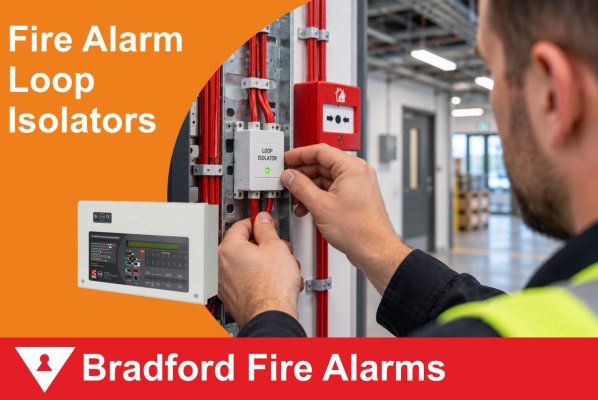
Fire Alarm Loop Isolators – A commercial fire alarm system may contain hundreds of individual devices connected by kilometres of cabling. If part of that cabling develops a short circuit, businesses need the remainder of the fire alarm system to continue providing as much protection as possible.
This is where short-circuit isolators become important.
Within many modern addressable fire alarm systems, isolators are used to limit the impact of electrical faults on detection loops. They are relatively small components, and most people occupying a commercial building will never know they exist, but their role can be extremely important.
For larger commercial premises in Bradford, understanding how a fire alarm system responds to cable faults is an important aspect of system resilience.
What Is a Fire Alarm Loop Isolator?
Addressable fire alarm devices are commonly connected to the control panel using a circuit known as a detection loop.
The cable leaves the fire alarm panel, connects numerous devices throughout the building and ultimately returns to the panel.
A short-circuit isolator is designed to detect certain electrical faults on that circuit and isolate the affected section.
Instead of allowing the fault to compromise a much larger proportion of the loop, the isolators on either side of the problem can disconnect the damaged section.
Devices elsewhere on the loop may then remain operational.
What Can Cause a Short Circuit?
Fire alarm cabling is designed to provide long-term reliability, but commercial buildings can be demanding environments.
Cable faults can potentially result from:
• Accidental cable damage
• Building maintenance work
• Water ingress
• Damaged equipment
• Incorrect alterations
• Mechanical impact
• Deteriorated connections
Construction and maintenance work can be a particular concern because cables may run above suspended ceilings, through service voids and alongside other building infrastructure.
A contractor working on an unrelated system may not realise fire alarm cabling is present.
Why Fault Containment Matters
Imagine a large Bradford warehouse with offices, production areas and storage facilities connected to one addressable loop.
If a cable fault occurred and the entire loop stopped operating, a substantial proportion of the building’s fire detection could potentially be affected.
Appropriately designed isolation helps restrict the consequences.
The fire alarm panel should identify that a fault has occurred, allowing investigation and repair, whilst unaffected sections can continue communicating.
This concept of fault containment contributes to the resilience of an addressable fire alarm installation.
Where Are Isolators Installed?
The precise arrangement depends upon the fire alarm system, manufacturer and system design.
Some installations use dedicated isolator modules positioned at appropriate locations on the loop.
Other modern addressable devices may incorporate isolation functionality within individual components.
The important consideration is not simply whether isolators exist, but whether the system has been designed so that a single fault does not result in an unacceptable loss of protection.
This requires careful consideration during the design stage.
Larger Buildings Require Careful Planning
Fault isolation becomes particularly significant as systems increase in size.
Examples can include:
• Manufacturing facilities
• Warehouses and distribution centres
• Schools and colleges
• Large office buildings
• Shopping and retail developments
• Multi-storey commercial premises
In these environments, losing a large number of detectors because of one damaged cable could have significant implications.
System architecture therefore matters just as much as the individual devices installed around the building.
Alterations Can Affect the Original Design
Problems can arise when an addressable fire alarm system is extended without considering its original isolation strategy.
Adding devices or altering loop cabling may change how the system behaves if a short circuit occurs.
This is one reason modifications should be undertaken by competent fire alarm engineers who understand the existing system architecture.
An alteration that appears straightforward may have wider implications for fault tolerance and system performance.
Finding an Isolated Fault
When a short circuit occurs, the fire alarm control panel will normally report a fault condition.
Engineers can then investigate the affected section of the loop.
Because isolators help restrict the fault to a smaller area, they can also assist with fault finding.
Instead of investigating an entire loop containing numerous devices, engineers may be able to narrow the problem to the section between two isolation points.
This can reduce diagnostic time and help restore full protection more quickly.
Testing System Resilience
Routine servicing is not simply about checking whether detectors activate.
Engineers should also consider the overall condition and operation of the fire alarm infrastructure.
Fault information stored by an addressable control panel can provide useful evidence of intermittent cabling problems, recurring device faults or communication issues that deserve further investigation.
Identifying these problems early can prevent more disruptive failures later.
Commercial Fire Alarm Systems in Bradford
At Bradford Fire Alarms, we design, install, service and upgrade commercial fire alarm systems throughout Bradford and the surrounding area.
For larger or more complex premises, careful consideration of detection loops, fault isolation and system resilience can help ensure that a single electrical problem does not unnecessarily compromise fire protection across a substantial part of the building.
Whether you operate a warehouse, manufacturing facility, school, office development or other commercial premises, we can assess your existing fire alarm system and advise on maintenance, modifications and upgrades.
For commercial fire alarm advice in Bradford, call 01274 458123 or email contact@bradfordfirealarms.co.uk.